
How Often Should You Service Your Coffee Machine?
A machine that’s never serviced doesn’t break overnight — it just quietly gets worse, cup by cup, until the coffee tastes flat and you can’t work out why. Here’s roughly when to act, based on what we see coming through our workshop, broken down by what’s actually going wrong rather than a one-size-fits-all number.
Descaling: the most common fix
Mineral build-up from tap water is the single biggest thing that slows a machine down and dulls the taste. As a general guide, descale every 1–3 months for home use, depending on your water hardness and how often the machine runs — softer water and light daily use can stretch that out; harder water or high daily volume should sit at the shorter end.
Scale builds up inside the boiler, the pipes and the group head, all places you can’t see without pulling the machine apart. It doesn’t just slow heating — it changes how heat transfers through the system, which changes extraction, which changes what’s actually in the cup. A machine that’s overdue for a descale often tastes muted or slightly metallic before it shows any obvious mechanical symptoms.
Water quality matters more than most people realise
If you’re on Sydney town water, hardness varies noticeably by area, and it’s worth knowing roughly where you sit before assuming a fixed descaling schedule applies to you. A simple, inexpensive water filter on your machine’s water line — or filtered water in the tank if your machine doesn’t have a built-in filter housing — meaningfully slows scale build-up and can stretch the interval between full descales.
Calibration: less obvious, still important
Grind, dose and extraction settings drift gradually — you won’t notice week to week, but a shot that’s been drifting for a year can taste noticeably different from when the machine was new. Pump pressure, thermostat accuracy and grinder burr wear all shift slowly with use, and none of them show up as an obvious fault — they just make the coffee slightly worse in a way that’s easy to blame on the beans instead.
If your coffee has quietly stopped tasting the way it used to and descaling doesn’t fix it, calibration is usually the next thing to check.
What a full professional service actually involves
It’s more than a descale. A proper service typically checks and, where needed, replaces worn seals and gaskets around the group head — the most common source of small leaks and pressure loss over time. It checks the thermostat or thermocouple against actual brew temperature, not just the machine’s own display, since a machine can report the right number while genuinely running slightly hot or cold. It checks pump pressure under load, not just at idle, and it strips and cleans the group head and shower screen, where old coffee oils build up and slowly turn rancid, tainting every shot that follows regardless of how fresh the beans are. On grinder-equipped machines, burr wear and alignment get checked too, since a worn burr set changes grind consistency in ways that look exactly like a “bad batch of beans” if you don’t know to look at the grinder itself.
Signs it’s time to bring it in
- Coffee tastes flat, sour or bitter with no change in beans
- Longer heat-up times than usual
- Unusual noises, leaks or error codes
- Milk isn’t steaming the way it used to, or takes longer to froth
- Visible scale or residue around the group head or steam wand
- It’s simply been longer than 12 months since the last full service
Different machines, slightly different needs
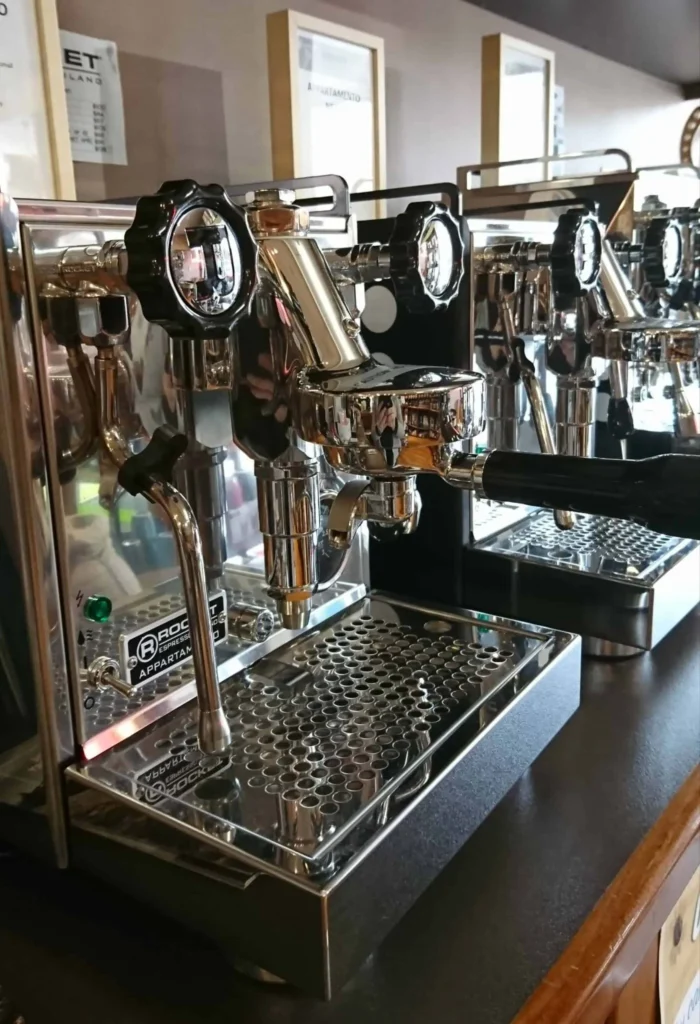
Manual machines like the Rocket range have more moving parts exposed to daily wear — group head seals, gaskets and steam wands — and benefit from a visual check-over even between full services. Jura’s bean-to-cup machines run their own internal cleaning cycles, but those cycles handle routine maintenance, not calibration or internal descaling at the level a full professional service covers — running the machine’s own cleaning program regularly is a good habit, but it isn’t a substitute for a proper service.
Home use versus a busy household or small office
Servicing frequency isn’t really about calendar time — it’s about cups pulled. A single-person household making one or two coffees a day wears a machine at a very different rate to a family of five, or a small office where the machine runs most of the morning. If your machine is getting genuinely heavy daily use, it’s worth erring toward the shorter end of the descaling range and keeping a closer eye on the warning signs above, rather than assuming the same 1–3 month rule applies regardless of how hard the machine is actually working.
Between services: small things that help
Wiping down the steam wand after every use, running a backflush (on machines built for it) periodically, and keeping the drip tray clean all reduce the load on the next full service. None of this replaces professional servicing, but it slows how fast a machine drifts out of condition between visits.
Keeping a simple record
It sounds small, but jotting down the date of each descale and service — even just a note on your phone — makes the whole schedule far easier to stick to. Without a record, most people simply forget how long it’s actually been, and “it’s probably due soon” quietly turns into eighteen months. A basic log also gives a technician useful context if something does go wrong between visits.
What happens if you simply skip servicing altogether
Nothing dramatic happens on day one, which is exactly the trap. Scale, worn seals and drifting calibration all compound quietly over months, and a machine that’s never serviced doesn’t fail all at once — it fails gradually, one slightly-worse cup at a time, until the drop-off is obvious in hindsight but was never obvious week to week. By the time a machine that’s been neglected for years actually stops working, the underlying wear is often more extensive than a machine that’s been serviced on a normal schedule, simply because problems that would have been small and cheap to catch early were left to compound against each other.
Why get it looked at properly, not just descaled at home
Home descaling solutions handle the basics, but they don’t catch calibration drift, worn seals or early-stage faults. We’re an authorised Rocket and Jura repairer based in Pymble, and every machine that comes in gets assessed properly — not just descaled and sent back out. We’ll tell you honestly what it needs, not what’s easiest to upsell.
How do I know if my water is “hard”?
If you’re on Sydney town water in most areas it’s moderately hard — if you’re noticing scale on kettles or taps, your machine will be affected too, and more frequent descaling is worth it.
Can I service my machine myself?
Basic descaling, yes, if your machine has a built-in cycle. Calibration and internal servicing need proper tools and should be left to an authorised repairer.
Do you service machines you didn’t sell us?
Yes, as long as it’s a Rocket or Jura — we’re authorised for both regardless of where you bought it.
Does a water filter actually make a difference?
Yes — a basic in-line or in-tank filter reduces scale build-up meaningfully and can stretch out how often you need a full descale.
My Jura runs its own cleaning cycle — do I still need a professional service?
Yes. The built-in cycle handles routine cleaning, but not calibration or the internal servicing that catches early-stage wear before it becomes a bigger fault.
Does a busier household need more frequent servicing?
Generally yes — servicing frequency tracks how many cups the machine actually pulls, not just calendar time, so heavier daily use means leaning toward the shorter end of the descaling range.